DESCRIPTION
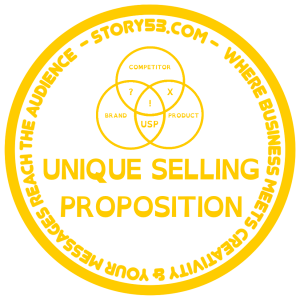
The “USP” storytelling method transforms the classic concept of a Unique Selling Proposition (USP) into a focused “one story”storytelling approach. Instead of telling broad, multi-layered stories, it builds a narrative around one sharp, differentiated idea that only this brand, product, or person can credibly claim.
The USP of the USP method is not just a feature, but the strategic core of it. Everything else just becomes supporting material. This method acts like a narrative magnet: it aligns messaging, simplifies communication and makes the story memorable as it is easy to focus and follow due to the “one” approach. In a world of overloaded messaging, the strongest stories are not the most complex. The strongest stories are the most distinct and repeatable. In business storytelling, this method is crucial for branding, positioning, marketing campaigns and personal storytelling, where clarity beats completeness.
ORIGIN
The concept of the Unique Selling Proposition was developed by Rosser Reeves for the company “Ted Bates & Company” somewhere between 1940’s and 1950’s. It later found its way to storytelling because of the simplicity of itself.
Approximately needed time
TOTAL: 2-4 hours

METHOD
MATERIAL YOU COULD NEED: Competitive landscape overview, customer insights and needs, product/service feature list
STAKEHOLDER GOOD TO KNOW: Strategist, product owner(s), sales representatives
STEPS
one
0%Explore the competition
You cannot be unique if you don’t understand what everyone else is offering. Step one is reserved for the market screening, competitors analysis, used and industry messaging. The goal is to identify patterns, clichés, and overcrowded narratives.
Supporting methods: MoSCoW prioritization, competitive analysis, content pillar mapping
Example: In SaaS marketing, many companies pretend to be “Easy to use.”, “Scalable.”, “Customer-centric.”
This is the so called “noise layer”, where differentiation does not exist.
two
0%Find the “core”
The USP must be something only you can own credibly and therefore also be the only one capable of “selling” it. Identify what makes the offering fundamentally different (e.g. unique feature, specific audience focus, a distinctive philosophy, an unconventional approach). The is the key to be specific in the eyes of your audience/customers.
Supporting methods: Jobs-to-Be-Done, 5 Whys method, empathy map
Example: you might go for “We eliminate meetings from your workflow.”, instead of “We improve productivity.”
Now the story has a sharp edge compared to the stories of your competitors.
three
0%Stress it to test it
Many ideas feel unique, but they aren’t until you test them to really find out. Test against three critical questions: “Is it truly different?”, “Is it relevant to the audience?”, and “Can it be proven?”.
This is the time and place where you want your weak USPs to collapse. Real and strong USPs survive, sharpen, and even delivers more additional ammunition for your arguments and messages.
Supporting methods: Scientific setup, customer insights/validation, MVP storytelling
Example: “Our drink refreshes you in summer!” isn’t a message no one else can use and therefore surely not the USP you want to handle.
four
0%Narrate your USP into the story
A USP without a story is just a statement. The story makes the difference and the difference makes the story. This is what’s gonna make your story memorable. Use tjhe opportunity to reinforce the USP.
Supporting methods: Story circle, PSI (Problem–Solution–Impact), pyramid approach
Example: “We eliminated meetings because we saw teams wasting hours in discussions instead of doing real work.”
five
0%Boom out the message
A USP only works if it is repeated and reinforced consistently and integrated across all communication channels like website, presentations, campaigns, sales conversations and social media. Consistency builds recognition and message enforcement.
Supporting methods: Content pillar approach, gamification loop, brand consistency frameworks
Example: Every touchpoint reinforces the message “We eliminate meetings.”. Over time, the brand becomes a synonym of that idea.
ADD
0%Most companies try to tell many good things. Great storytellers choose one tricky or even dangerous truth.
Because in the end: You don’t win by being better. You win by being different in a way people remember.
more
0%PROMINENT BRANDS USING IT:
Deutsche Telekom = Connecting your world
- Volvo = Safety
- Apple = Simplicity and design
- Dominos Pizza = Ffast delivery
- M & M’s: = “Melts in your mouth, not in your hand”
Each brand owns a clear, memorable message.
ANECDOTE:
Domino’s Pizza once built its entire business around a bold USP: “Delivered in 30 minutes or it’s free.”
It was risky, specific, and operationally demanding, but incredibly clear to all. Customers didn’t need to compare features or quality claims. The decision was simple.
The result: massive growth driven by one unforgettable promise.